When I was 13, I modded Pokemon GBA ROMs.
Not the code — I didn’t know how to program yet. But I found a tool that let me edit the game files directly. Change the wild Pokemon on each route, redesign maps, build my own version of the game. I knew every map by memory. I spent weeks building what I thought was the perfect Pokemon game.
Then I wanted to share it. I posted it on a forum and got some good feedback, but I wanted my own space — somewhere I controlled. So I built a simple HTML website, uploaded the ROM, and put it on the internet.
That was the first time I published something online. I was hooked.
The pattern
Over the next few years, I kept building. A community site for a fighting game called Little Fighter 2 — complete with auth, a forum, and a mod upload system where I’d review submissions in an admin panel before publishing. I taught myself ASP and Access DB over a single summer vacation to build it. Kids at my school used the site and recognized me in the hallways.
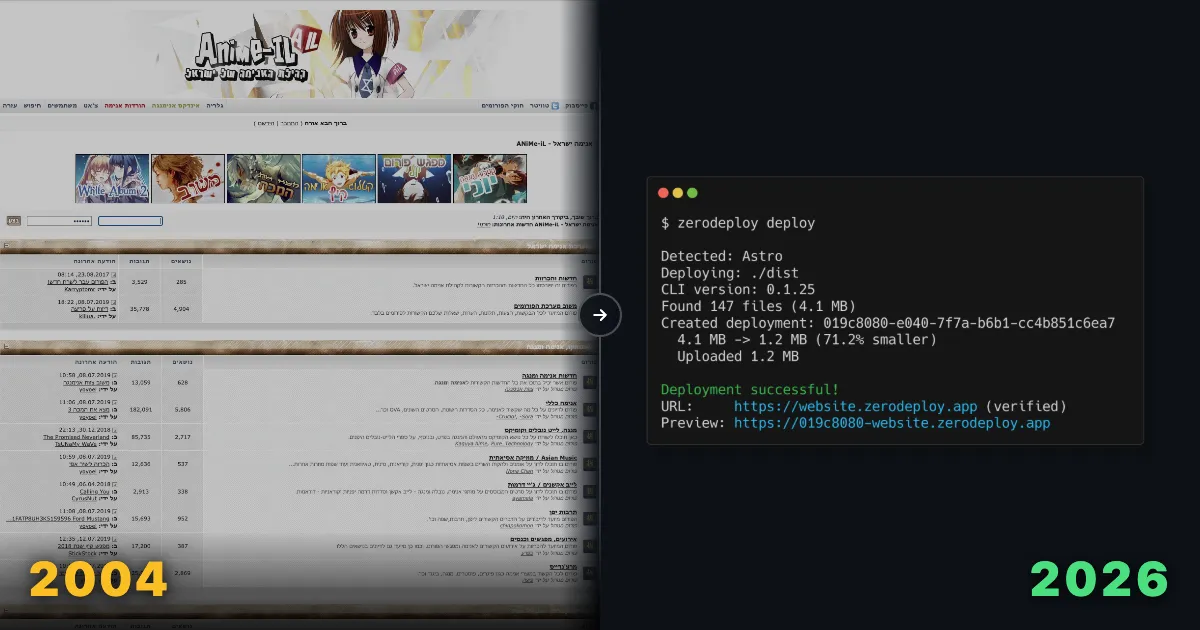
Then a friend I met on IRC introduced me to Naruto. We built an Israeli fan site together — he designed it, I built it in PHP and MySQL. That led to another anime site, then another. I noticed the same users kept showing up across all the forums, so I did the obvious thing: I extracted the community into its own domain. Anime-IL. The Israeli community for anime.
By the time I was 16, that site had over 120,000 registered users and 10 million posts. It was the largest anime community in Israel. I ran it from 2004 to 2010 — and it’s what turned a hobby into a career.
The point isn’t the numbers. The point is that I’ve been doing the same thing for 24 years: building platforms for people to put things on the internet. ZeroDeploy is the latest version of that instinct.
The gap
After Anime-IL, I went professional. I was the first engineer at multiple startups, co-founded others, built products from zero to launch. I cared obsessively about UX and performance — the kind of developer who thinks about every millisecond a user has to wait. Eventually I moved into engineering management. I’ve been managing for the past four years. I took it as a challenge — managing people requires different skills than writing code, and after so many years of coding I wanted to grow in a new direction.
But I missed building. Four years is a long time to watch other people write the code.
I wanted to publish my personal website. Simple: a few pages, a contact form, some basic analytics to see if anyone visits. The kind of thing that should take an afternoon.
The options didn’t fit. Vercel and Netlify are powerful tools — I genuinely like the experience of preview environments and GitHub integration. But I’d heard enough stories on Hacker News about surprise bills when a site gets popular. A $5 VPS with nginx would handle the traffic, but then you’re managing security patches, SSL certs, monitoring, log rotation — weekends lost to infrastructure, just to serve static files.
Cloudflare Pages had a generous free tier and fast infrastructure, but the dashboard was slow, settings were hard to find, and the developer experience didn’t match the backend quality.
And for a simple personal site, none of them solved the whole problem. I needed hosting, a contact form, and analytics. That meant three accounts, three dashboards, three billing relationships — and an afternoon I’d never get back. For a personal website.
I’d had the idea for a simpler deployment platform for years. But I work a full-time job. I didn’t have the energy to build it in my spare hours.
Then something changed.
The unlock
LLMs matured. I started using Claude Code, and suddenly things I’d been thinking about for years became buildable at a pace that matched the ideas in my head.
I knew exactly what I wanted — I’d been designing it mentally for years. Instant deploys, forms that just work, analytics without JavaScript tags, custom domains without the pain. LLMs didn’t give me the vision — they gave me the leverage to build it solo, without compromising on quality. I was dogfooding the platform immediately, using ZeroDeploy to host its own website, dashboard, and admin panel.
At my day job, I ran an experiment. We had an old service maintained by a single developer — a mess no one else wanted to touch. I prepared a detailed plan and gave it to Claude Code. In under a day, I’d rebuilt 80% of the service. It was a prototype — it needed hardening — but it changed my understanding of what a single person can build.
That was the moment I knew I had to start.
Now I work on ZeroDeploy after hours. Usually 8 PM to midnight. My brain doesn’t stop thinking about what to build next when I try to sleep. Every feature gets the same obsessive attention to detail I’ve brought to every product I’ve ever shipped — LLMs handle the velocity, but the standards come from 24 years of putting things on the internet. It’s the same feeling I had at 13, uploading that Pokemon ROM to my first website. From idea to URL.
The decisions
ZeroDeploy is static-only. No server-side rendering, no serverless functions, no backend. Some people would call that limiting. I call it a decision.
Most websites don’t need SSR. The ZeroDeploy marketing site, the user dashboard, the admin panel — all static. Fewer moving parts means fewer things that break. It means deploys take seconds instead of minutes because there’s no remote build queue. You run zerodeploy deploy and get a live URL. Under 5 seconds.
Forms and analytics are built into the platform, not sold as add-ons. One tool that does the job, not three tools duct-taped together. When I built my personal site, the thing I hated most was needing a separate account for forms and another for analytics. So I built them in. Every plan, including free.
Pricing is $29/month flat for Pro. Vercel and Netlify both charge $20 per developer per month — and that’s before you start paying for the extras. ZeroDeploy is $29/month flat — forms, analytics, custom domains, everything included. No per-seat costs. Add a teammate and it’s still $29. Generous included limits — 10 GB storage, 10 million requests — and transparent usage-based pricing beyond that. Per-seat pricing for a hosting platform never made sense to me — your costs scale with storage and requests, not with how many people are on the team.
The demo
A few weeks ago, two close friends and I were catching up over drinks. I pulled out my laptop — wasn’t planning to demo ZeroDeploy, but figured why not.
I asked Claude to build a simple site: three pages, one for each of us, with a message form on each page. It was ready in a minute. I deployed it with a single command, got back a URL, and handed them my phone.
“Write something on each other’s pages.”
They did. Then I opened the dashboard and showed them the submissions — their messages, saved and searchable, no backend code involved. Both of them are developers. They got it immediately.
That’s the product working the way I think it should: from idea to live site with working forms in under two minutes.
What’s next
I’m a solo founder, building after hours, using the platform to host its own website, dashboard, and admin panel. The core product is built. The marketing — that’s the part where I have less experience, and where I’m focused now.
I’m not going to pretend this will definitely work. I have a mortgage. I have two kids. The responsible thing would be to keep managing and collect a stable paycheck.
But I’ve been putting things on the internet since I was 13. First for myself, then for communities, now for other people who want to do the same thing. The tools keep changing. The instinct doesn’t.
The next challenge is one I’ve never faced: convincing people who don’t know me to trust a platform that didn’t exist a year ago. I’m figuring it out in public, one deploy at a time.
ZeroDeploy is free and open to everyone. If this resonates — if you’ve been putting things on the internet too — try it now. Drop your files and get a live URL in seconds.